90% Guardian
Tuesday, 18 December 2012
Friday, 30 November 2012
Warren Buffett's Wisdom
I can't believe I am writing this. When I first touched the investing arena, I have liked Warren Buffett just like many people did. But now, after I learned a thing or two more than before, and grew a bit older (and hopefully wiser), I learned that Warren Buffett is nothing but a political and financial hack who somehow, through his influence, made himself appear as "the guardian of the little people" in the lamestream media (and the ridiculous part is people bought the story).
But in this article, I want to share some of his wisdom. Warren Buffett is still (don't know how long it will be) regarded as one of the best investors in the world. He does share his thoughts with people. However, when listening to him (even when he is actually sharing something legit), it is very easy to misunderstand what he actually means. People who merely listen and don't have the financial intelligence to "decode" his saying will often get slaughtered in the end because they misunderstand the concept Buffett is sharing.
This article is to "decode" some of the wisdom that Buffett has.
So, without further ado, let's go into what Warren Buffett has to say!
Buffett said: "Rule #1: Never lose money. Rule #2: Never forget Rule #1."
People without an investor mindset, upon hearing this, would just decide to stay out of the investing arena and "play it safe" (possibly do something non-sense like buying into a GIC or some government bonds). However, with a bit of common sense, we will see that what most people consider at "risk-free" investment is only a "guaranteed loss" thanks to inflation and low interest rate. How is it following Buffett's wisdom when all your are guaranteed is a steady loss?
The truth is, real investors do a lot of due diligence to understand an investment before putting money in the game. Real investors understand their returns and their risks. Real investors invest with insurance. For example, in the stock market, you can sell puts to buy stocks at discount, and sell calls to cash-flow your stocks risk-free. In the commodity market, you can study supply and demand of an item and predict the long term trend of price movement. These are some examples of how people can earn money simply by learning how to play the game. By enhancing your knowledge, you can ensure you won't lose money and will make great returns!
Real investors ensure their investment won't lose money. They do not put their money into so-called "risk-free" investment vehicles that guarantees nothing except loss.
Buffett said: "Only buy something that you'd be perfectly happy to hold if the market shut down for 10 years."
Buffett said: "Our favorite holding period is forever."
In my opinion, this is the most often cited and most misunderstood statement made by Warren Buffett. Maybe you've seen someone like this too. When you ask them how their investments are doing, they reply, "I am a long-term investor. Have you ever heard what Buffett said?"
These people who say this kind of things often are losing money. And because they are losing money, they are in for the long-term. Heck, I was also like this in the past!
The problem with these people is that, they thought the holding period of an investment is determined by themselves, so they are holding their investment for "long-term", believing that long-term investors always win. This is a completely wrong concept. The truth is, the INVESTMENT determines the holding period of an investment, not the INVESTOR!
Let's look at an extreme example. If there is an investment that give you 100% cash flow, and appreciate in value 100% annually (in real value), how long would you hold this investment? I hope your answer is forever.
What about an investment that loses 50% value everyday? How long would you hold this investment? I hope your answer is never. But the funny part is, some people would decide to hold an investment like this for the long-term, just becasue Buffett said "You shouldn't hold something for a minute if you are not planning to hold it for 10 years."
So to recap, the INVESTMENT, not the INVESTOR, determines how long one should hold an investment for. The investor's job is to find the excellent investment that is good to hold on to forever, and sit on it forever, NOT holding onto every investment forever.
Buffett said: "Wide diversification is only required when investors do not understand what they are doing"
When people mention diversification, they usually means they have money into stocks of different sectors and industries, and maybe also some money in bonds.
This is the kind of diversification that Buffett condemns.
True diversification is diversification into different asset classes. This means putting money into businesses, paper assets (stocks, bonds, etc), real estates, and commodities. Just look at Warren Buffett himself. He has a business (Bershire Harthaway) that invests in other businesses and different paper assets. Diversification is great, but it's non-sense to just go wild in one asset class and think you are diversified.
Buffett said: "Derivatives are financial weapons of mass destruction."
Derivative is simply "an item that is derived from another item". For example, orange juice is a derivative of orange. Derivatives are not intrinsically evil. For example, when someone buys a house, the mortgage agreement is a derivative of the real estate. This is very normal and there is nothing wrong with it. However, the problem arises when Wall Street gets creative, and then they started to create investments that are based on the mortgage agreement. And then they create investments that are based on the investment that is based on the mortgage agreement. So what you get is a derivative of a derivative of a derivative of a derivative, and on and on and on.
Still, there is nothing intrinsically evil about it. The evil part is when corrupted rating agencies rank these derivatives AAA (meaning risk-free). Just by understanding the concept of a derivative, we can see they are very high risk, since if any part of the derivative chain shows weakness, the derivative gets destroyed. When these poisonous investments get rated as "AAA", you get people world-wide buying them. Even funds that would usually go for low-risk investments, ended up getting these poisonous assets. Once the underlying asset value goes down the drain, then so does all the derivatives derived from it. In this case, it is definitely weapons of financial mass destruction (on a side note, why the rating agencies are still in business and people still take them seriously is beyond me).
However, to sound like a broken record, THERE IS NOTHING INTRINSICALLY WRONG WITH DERIVATIVES. Derivatives can be weapons of mass financial destruction and can also be weapons of mass financial creation. It just depends on how it is used.
The lamestream media most often only cite Buffett's quote of financial mass destruction, but they often leave out the one below, which I believe Buffett explains it best of the nature of derivatives:
"We've used derivatives for many, many years. I don't think derivatives are evil, per se, I think they are dangerous. ... So we use a lot of things daily that are dangerous, but we generally pay some attention to how they're used. We tell the cars how fast they can go."
Addendum: Warren L.C. Buffett (Warren Liar.Crook. Buffett)
WARNING: IF YOU REALLY LOVE BUFFETT AND ALL YOU WANT TO READ IS HOW GREAT WARREN BUFFETT IS, AND HAVE NO INTEREST IN LEARNING OTHERWISE, YOU SHOULD STOP READING AT THIS POINT. ELSE, KEEP READING.
NOTE: I AM MERELY STATING FACTS HERE, AND AM NOT RESPONSIBLE FOR ANY HURT FEELING THAT THE WRITING MAY CAUSE.
Buffett said: "If you're in the luckiest 1% of humanity, you owe it to the rest of humanity to think about the other 99%"
Good job Buffett, what a hypocrite you are! If what you say is true, then obviously you never think about or care for the other 99%. Remember the bailout in 2008? Why did you support it? Oh, that's right, if there were no bailout, you would've lost your under pant already. If the government DID NOT PRINT SO MUCH MONEY TO LOOT THE WORLD POPULATION'S PURCHASING POWER AND GIVE IT TO YOU AND YOUR CRIMINAL WALL STREET FRIENDS, you would be broke by now! DAMN RIGHT YOU OWE THE OTHER 99%. When the hell are you going to pay us back?
So much for thinking about the other 99%. The truth is, true capitalists DO NOT need to think about the other 99% (though many of them, unlike Warren, do), because as they make profit, they are providing values to the society and are creating a better world (heck, this is why true capitalism is so beautiful... you can make other people better off by just thinking how to enrich yourself!). Steve Jobs is possibly one of the biggest known assholes in the Silicon Valley, and yet when he was alive he was constantly being idolized by the public. Why? Because THROUGH HIS PROCESS OF ENRICHING HIMSELF, HE CREATED VALUES FOR EVERYONE IN THE WORLD!
But financial hacks like you, Warren, would never understand free market economics, because you haven't created values for the 99% for a long time, and you don't care about them. Walk your talk for once, please (but I bet you will not until you lose your under pant).
Buffett said: "If anything, taxes for the lower and middle class and maybe even the upper middle class should probably be cut further. But I think that people at the high end - people like myself - should be paying a lot more in taxes. We have it better than we've ever had it."
What a crook Warren. Can you be honest just once?
First, if you loooooooooooooooooooooooooooooooooooove to pay tax, no one is stopping you from writing a big fat cheque to the US treasuries. I am sure your criminal friends in Washington D.C. would appreciate it.
Second, question: Who creates jobs in the society for the middle-class and the poor? That's right, the rich! Oh, you are going to tax the rich more. Great! Less capital for the rich, so less jobs will be created! Then why should we lower taxes for the poor and the middle-class; they wouldn't even have an income to pay tax anyways!
Third, only people who own mega corp like you, Warren, are not paying taxes. You can hire hundreds of accountants to do tricks to avoid paying taxes "legally", while a smaller business does not have the resource as you do. In fact, rich people are taxed to the hill. If they own a business, the business pays a corporate tax. And then, if the rich person has income from the business, those income gets taxed. Real tax rate is more like 50%, and we want to tax them more so there is less capital for the society?
You know what, Warren, I have a better idea. How about we LOWER TAX ACROSS THE BOARD FOR EVERYONE? The society will all benefit, except the parasitic government. It would force government to shrink, which is awesome! Why don't we do that?
Oh, I know, because IF GOVERNMENT SHRINKS, GOVERNMENT WOULD NOT HAVE "GOODS" TO SELL TO CROOKS LIKE YOU, Warren. Without the government's power to help you out (like bailing your buddies out so you can earn big), you would not have the competitive advantage! Moreover, if we lower tax rate for rich people, the smaller businesses would become more competitive and compete with you! Of course you don't want it!
You can fool others, but narrow-minded self interest does not impress me.
Buffett said: "Gold gets dug out of the ground in Africa, or some place. Then we melt it down, dig another hole, bury it again and pay people to stand around guarding it. It has no utility. Anyone watching from Mars would be scratching their head."
This is a famous quote by Warren L.C. Buffett on gold. A lie cannot be as blatant as this.
First, gold has HUGE utility. No, not just for jewelry. Do you know the little brother of gold named silver? Silver is the second most useful commodity in the world (oil is the first). Now, do you know what the perfect substitute of silver is? That's right, it's GOLD.
And gold has no utility according to L.C. Buffett
The reason that people DON'T use gold is because gold is too expensive. In fact, back in the days when gold's price was low, Intel would use gold to make something like the following:
And gold has no utility according to L.C. Buffett.
Gold actually has HUGE utility, but people don't use it because historically, gold's financial value is a lot higher than its utility value. Let me explain this with an example: Take out a 5 dollar bill from your wallet. Your 5 dollar has the utility of creating heat when you burn it (it's sad that you can't even write on it because they already put ink on the paper). But would you burn it? NO, because the 5 dollar bill has a value higher than the heat it creates (at least for now, before the fiat currency collapses).
Historically, many items have been used as money by humans (salt, gems, shells, stones, etc). But the only item(s) that are used and accepted by everyone has been gold and silver. The British smuggled opium to China and fought the opium war because the British was running out of silver due to high volume purchases of Chinese goods (great trade deficit created deflation in United Kingdom). The Spanish crossed the Atlantic to go to the New World to find gold. GOLD IS MONEY.
And it has no value according to L.C. Buffett.
You might say, "well, Warren Buffett's concentration is on business and paper assets. He might just not understand gold and silver and he's not deliberately lying."
Oh yeah? Sure. Although I would never believe one of the greatest investors in the world would not understand gold, I would give him the benefit of the doubt. How about we take a look at what this man named Howard Buffett has to say about gold?
Full version:
I warn you that politicians of both parties will oppose the restoration of gold, although they may outwardly seemingly favor it, unless you are willing to surrender your children and your country to galloping inflation, war and slavery then this cause demands your support. For if human liberty is to survive in America, we must win the battle to restore honest money. There is no more important challenge facing us than this issue - the restoration of your freedom to secure gold in exchange for the fruits of your labors.
Howard Buffett is Warren Buffett's father. He was a congressman of the United States of America. Throughout his political life he fought to restore constitutional money in the society (did I tell you by the US constitution, only gold and silver can be money... so the current US Dollar backed by nothing is actually illegal?)
And you want me to believe that, as the son of Howard Buffett, Warren does not understand the financial role gold and silver plays in a honest money system for the society? Give me a break.
Warren, your father was a true hero, and you are nothing but a crook. He was un-corruptible and had the guts to stand against the powerful beneficiary of the fiat money system, and yet you sold your soul just so you can make a some bucks.
Your father must NOT be resting in peace seeing how his son helps destroys the constitution he so furiously tried to protect. Good job!
Buffett said: "Of the billionaires I have know, money just brings out the basic traits in them. If they were jerks before they had money, they are simply jerks with a billion dollars."
Well said Warren. That's why you were, you are, and you will always be a liar and a crook. Reason? you explained it very well yourself. WELL DONE.
Tuesday, 13 November 2012
A Look At Indonesia
Since I have just gone to Indonesia, I would like to share some thoughts on this country from an investment perspective. Note: This article is highly opinionated and I lack deep knowledge regarding to this country. If you think any information here is inaccurate, chances are you are probably correct.
First, let's look at some of the fundamentals of Indonesia that may attract investors:
Despite all this good stuff, I am not enthusiastic in investing in Indonesia any time soon. The reason is that in my opinion, the Indonesian government is extremely incompetent. One of the problems to show the government's incompetency is a major issue in Jakarta: Traffic Jam.
Jakarta has possibly the worst traffic jam in the world. During most of the time of a day (like 8 am to 9 pm), traffic jam can be found anywhere in the city. A simple distance of 10 to 20 km could take a few hours to travel. Traffic jam has always been a problem in Jakarta. It was already bad when I was in Indonesia about 10 years ago. Today, the problem has not improved a bit and has actually got worse. We all know traffic jam problem can be improved by more (and better) roads, plus mass transportation. Unfortunately none of this happened. Roads are the same old roads, and there is still only one marginal mass transit system in place, which is a bus system that does not have bus appear often (that's why I use the term "marginal"). There has been "talk" about a subway for more than 30 years, but it has been merely "talk", and the project has been postponed and postponed and now they "say" the project will start in 2012. We will see about that.
Oh and don't forget, we are talking about Jakarta, the capital of Indonesia here!
The traffic jam problem is an example to show the government's incompetency. But not only is the government incompetent; the government is also very corrupted. It is very common that if you get pulled over by the police, the police would blatantly asks you for "coffee money" (I saw this happened to my uncle a few times). If you are a Chinese and you try to enter or exit Indonesia, the Indonesian custom would very likely not let you go through until you offer a bribe (oh, this actually happened to me the first time I went to Indonesia, so I know what I am talking about). The Indonesian government is the biggest reason I would NOT put my money and time in Indonesia.
Now, some of you who know me might now say, "what the heck Jammy, what do you want? I thought you are for all the free-market and capitalism stuff. Why are you now complaining that the Indonesian government is not doing much to the society?"
Now, let me make it clear:
First, let's look at some of the fundamentals of Indonesia that may attract investors:
- Indonesia is in an excellent location of the Pacific Rim. To its north is China (Great demand for resources), to its south is Australia (Great repository of resources, which they must pass through Indonesia if they want to sell their stuff to China). It also holds the Malacca Strait (One of the most important strait) and can reach India going west. To the east of the country is the vast Pacific Ocean.
- Indonesia is rich in natural resources. Some resources are oil, natural gas, coal, gold, and silver.
- Indonesia, with its huge population of almost 240 million people, has huge potential to be a manufacturing powerhouse of Southeast Asia, as it has a huge cheap manpower corporations can take advantage of.
- Indonesia has rich, fertile soil and is located on the equator, which means the country also has the factors necessary to be a agricultural powerhouse.
- Indonesia has great tourist resources to be developed. The country has always been held by many different tribes and different groups of people. This created a great variety of cultures for visitors to explore. With its abundance of beautiful shorelines, Indonesia is a gem for vacation.
Jakarta has possibly the worst traffic jam in the world. During most of the time of a day (like 8 am to 9 pm), traffic jam can be found anywhere in the city. A simple distance of 10 to 20 km could take a few hours to travel. Traffic jam has always been a problem in Jakarta. It was already bad when I was in Indonesia about 10 years ago. Today, the problem has not improved a bit and has actually got worse. We all know traffic jam problem can be improved by more (and better) roads, plus mass transportation. Unfortunately none of this happened. Roads are the same old roads, and there is still only one marginal mass transit system in place, which is a bus system that does not have bus appear often (that's why I use the term "marginal"). There has been "talk" about a subway for more than 30 years, but it has been merely "talk", and the project has been postponed and postponed and now they "say" the project will start in 2012. We will see about that.
Oh and don't forget, we are talking about Jakarta, the capital of Indonesia here!
The traffic jam problem is an example to show the government's incompetency. But not only is the government incompetent; the government is also very corrupted. It is very common that if you get pulled over by the police, the police would blatantly asks you for "coffee money" (I saw this happened to my uncle a few times). If you are a Chinese and you try to enter or exit Indonesia, the Indonesian custom would very likely not let you go through until you offer a bribe (oh, this actually happened to me the first time I went to Indonesia, so I know what I am talking about). The Indonesian government is the biggest reason I would NOT put my money and time in Indonesia.
Now, some of you who know me might now say, "what the heck Jammy, what do you want? I thought you are for all the free-market and capitalism stuff. Why are you now complaining that the Indonesian government is not doing much to the society?"
Now, let me make it clear:
- As I said, the Indonesian is not a "do-nothing government". The opposite stands. The government is doing a lot, but what it does is not to develop the society but to enrich those running the government. i.e. government corruption.
- A do-nothing government only works when the free-market and capitalism mindset has set a foothold in the society. If there were no capitalism in the society, it is necessary for the society to have an environment that attracts foreign capitalists and allow capitalism to nurture. In this case, the government would need to be involved in creating such an environment.
In Indonesia's case, both case 1 and case 2 stand true. The government is corrupt, and the idea of free-market capitalism has never really flourished in Indonesia. Let me explain in more details.
First, let's get it straight the definition of free-market capitalism before we go further. Capitalism is a social system which private property is recognized. We may take this idea for granted today, but in reality the idea of private property did not really exist (or only existed in short bursts) in most of human history. For example, for the longest time eastern civilizations are ruled under monarchy. Under a monarchy properties of a society all belong to the monarch, and the monarch can take away your "private" properties any time the monarch wants (Yes you can still have capitalists and in fact China had a long history of capitalism and merchant class. But the idea of private property is not protected by the system/law). In the west it has long been strong feudalisms in different countries, and under a feudalism you only have the ruling class and the serfs in the society. Everything the serfs produce belong to the ruling class. No capitalism there.
In short, capitalism is a system of "private earning and private loss". So as a side note, our current society is NOT a capitalistic society, because what we have is "private earning and socialized loss". For those of you who blames capitalism for the current unfairness of the society that some people get all the goodies from the government while other people get nothing, you are blaming the wrong thing. What we have today is called crony capitalism, a.k.a. fascism. This brings us to the next concept: Free market.
The concept of free market, simply put, is a system that individuals are left alone to do what they want, and there is no government picking and choosing favorites. This means that the government NEITHER prohibits NOR subsidizes people for doing anything. Again, this is another major point to be made regarding to today's western world. There is NO free market thanks to all the laws known as minimum wage, maximum work hours, unemployment insurance, forced pension plan, health care, etc. Some say a true free market should not have a government. I am more for a minarchy, which government should only be confined in its power to protect personal properties (e.g. punishes stealing), enforces contracts, and protects basic rights laid out in a country's constitution (which should be written by the common people), and nothing more. I digress, but you get the idea of what free market is.
Now let's go back to Indonesia and take another look. Is there free-market? In certain areas sure, like the currency of Indonesia is freely convertible. But in general in Indonesia, you have a corrupt government picking favorites, so it's far from what you expect from a free-market economy. What about capitalism? There are capitalists in Indonesia, but if you take a look, you will see something very interesting: A lot of rich capitalists in Indonesia are NOT of aboriginal Indonesian heritage (for example, try to google top 100 richest Indonesian). In fact, you will find a lot of capitalists to be of Chinese heritage. Based on my observation, capitalism has not set foot in majority of the population in Indonesia.
I can share a personal story. When my family visited Indonesia about a decade ago, my family stayed at my uncle's place. My uncle is a business man in Jakarta and he hires some maids and a driver (this is very normal for upper middle-class in Indonesia, so please don't think that somehow my family has some business empires in Indonesia). The first time my family went to Indonesia, on the day we left my dad gave $100 USD tip to the driver on behalf of the whole family. This is about 960,000 IDR, which is about 3 - 5 day wage for the driver. Guess what happens next? That's right, the driver right away took 3 days off work (which obviously pissed my uncle off). Apparently, this is not a secular case; it is a general attitude of workers in Indonesia. This is of significant importance because a society's savings is the base for capitalism's success, and the mentality to save capital is not in the working class of Indonesians. Savings is what entrepreneurs need in order to build assets that will enrich themselves and the society. It is very sad to see Indonesia has so much resource and so much potential, but there is a serious lack of capitalistic minds to take advantage of all the potentials.
When a society lacks capitalism, the government would need to step in to create an environment that would attract outside capitals and knowledge in order to help nurture local capitalists. However, as mentioned before, the Indonesian government is too busy making itself rich and puts little effort into developing a better Indonesia. Can you succeed in doing business or investing in Indonesia? Sure, but as I said the environment is not great with your money, so you need to be more cautious and more skilled to find success as a foreigner. I am not excited to put any money there, unless I see a change in the government: A government that works on developing a better environment for capitalists and is less corrupt. When that happens, I can guarantee you will see some legit economic growth, and if Indonesia has some great economic mind like Lee Kuan Yew running the country (love him or hate him, he DID turn Singapore from a underdeveloped colonial outpost to a Southeast Asian economic powerhouse), then you shall see Indonesia explode into a Southeast Asia superpower.
Tuesday, 25 September 2012
Your Biggest Enemy (3): Common Psychological Traps to Avoid
In the last part of the series, we will go over the common psychological traps that we will face everyday in our journey to success. When you understand these common human phenomenons, you will be more likely able to bring the little voice into the conscious field and have a good fight.
Cognitive Dissonance
Simply put, cognitive dissonance is the discomfort a person feels if there is a difference between the person's beliefs and his/her actions. For example, back in the days in World War II in Nazi Germany, you would have people who are good in nature performing massacres on others. These people experienced a lot of cognitive dissonance. The most important thing about cognitive dissonance is that, when there is cognitive dissonance and the dissonance is left un-touch, eventually the ACTION would overwhelm the mind and change the beliefs of the person. In the example of people in Nazi German, as they continue to do what they were ordered to do (they continue to perform evil deeds even though they are good people), they eventually adopted the evil beliefs and become people of evil nature.
Parkinson's Law I: Work expands to meet the envelope of time allows.
I also like to call this "the law of procrastination". This law states that, a person would expand the time needed to finish a task to use up the maximum allowable time. For instance, if there is a task that you are assigned to finish in 3 days, you will probably have the work done by the end of the third day. Now, if you are given 30 days to do the same work instead, surprise surprise! Your task will be very likely to get done by the end of the 30th day!
The sad reality is that, not only does our school fails in teaching people in managing their money, it also fails big time in teaching people in managing their time. Of course, many people may argue that this is not true, as tasks from school often include a deadline. Meeting a deadline requires using your time wisely, so how could I say school fails to teach people time management? Though I do agree that being able to meet deadline is an important skill, but by Parkinson's Law II, we can see that there is a even more important skill: It is the skill of GIVING YOURSELF A DEADLINE. For many important things in life, there is no deadline given to you and you must give yourself a deadline. For example, financial education is extremely important, but would anyone tell you you have to finish something by a certain time? No, you have to define your own deadline. If you don't have time, you will just slack off and never achieve anything, since your envelope of time in this case is infinity.
We must understand that expense and liabilities will hinder our path to financial freedom. It is WEALTH that we need to concentrate on, not just income. Failing to understand Parkinson's Law II would easily make you a high-income person who goes broke.
Parkinson's Law III: A luxury, once enjoyed, becomes necessity
This law goes hand-in-hand with Parkinson's Law II. It explains why it is so difficult for people to lower expenses once they allow themselves to fall into the trap of Parkinson's Law II. This is, by no means, encouraging you to live under your means. Instead, you should expand your mean before you start enjoying a luxury. For example, you should create or acquire an income generating asset, before engaging in acquiring a luxurious liability.
If you understand Parkinson's Laws and are able to overcome these psychological traps, you are already way ahead of the financial game, as overcoming these traps require a great level of financial intelligence.
Normalcy Bias
Simply put, normalcy bias is the phenomenon that people tend to disregard things that are not "normal". Human beings have a tendency to only accept information that are within their own understanding and will reject things as impossible if they are beyond the mind's comprehension. This is especially the case when there is a disaster, where people could not imagine a disaster could hit, and end up costing their lives (the Southeast Asian Tsunami was a good example. A lot of people did not leave the shore and watch the tsunami came in as if nothing had happened).
Normalcy bias contributes to our lack of actions and gives us a false sense of security that everything is fine and dandy and there is no urgency to take actions. The best way to overcome normalcy bias is to expand your mind's context and content. Once you learned more, you would find that a lot of things that seem impossible to happen are really just history repeating itself in a different form. Once you learned more, what seemed impossible and abnormal before would become normal, and you will no longer ignore these events and won't become a victim of your normalcy bias.
Arrival Syndrome
This is a psychological trap related to the normalcy bias. It describes the phenomenon of people believing that they are perfect as they are. People generally think they are good as they currently are, that they "have arrived" at their goal already. We often see these kind of people. When you ask people, say, what kind of life style they want to live, or when they want to retire, they will tell you they want as much as possible and want to be financially free as early as possible. However, when you start to talk to them more about it, they would immediately tell you how happy they are with their own life, how awesome it is to work on something that they will never own and cannot sell (a.k.a. a job), and get to have 15 days of vacation each year.
Again, the Arrival Syndrome causes us to stand still and not make necessary changes or take necessary actions. A burning desire is a must in order to overcome the arrival syndrome.
Sun Tzu said, "know your enemy and yourself, and you will never fear a hundred battles."
In the path to financial freedom, on top of knowing the different skills needed to play the financial games, it is just as important to know yourself. You are indeed your biggest enemy that you must overcome.
Cognitive Dissonance
Simply put, cognitive dissonance is the discomfort a person feels if there is a difference between the person's beliefs and his/her actions. For example, back in the days in World War II in Nazi Germany, you would have people who are good in nature performing massacres on others. These people experienced a lot of cognitive dissonance. The most important thing about cognitive dissonance is that, when there is cognitive dissonance and the dissonance is left un-touch, eventually the ACTION would overwhelm the mind and change the beliefs of the person. In the example of people in Nazi German, as they continue to do what they were ordered to do (they continue to perform evil deeds even though they are good people), they eventually adopted the evil beliefs and become people of evil nature.
If you understand how cognitive dissonance works, you would understand the importance of actions. It shows that we can change our mind by taking actions! Sometimes your mind might not be completely prepared and you may not feel comfortable in doing something, but do it! If you do it enough, your action will eventually change your mindset. On the other hand, if you just have a good idea in your mind, but you don't take any action, your lack of action would eventually turn your good idea into null. Talk is cheap, thoughts are nothing. ACTION is everything!
Parkinson's Law
Parkinson's Law I: Work expands to meet the envelope of time allows.
I also like to call this "the law of procrastination". This law states that, a person would expand the time needed to finish a task to use up the maximum allowable time. For instance, if there is a task that you are assigned to finish in 3 days, you will probably have the work done by the end of the third day. Now, if you are given 30 days to do the same work instead, surprise surprise! Your task will be very likely to get done by the end of the 30th day!
The sad reality is that, not only does our school fails in teaching people in managing their money, it also fails big time in teaching people in managing their time. Of course, many people may argue that this is not true, as tasks from school often include a deadline. Meeting a deadline requires using your time wisely, so how could I say school fails to teach people time management? Though I do agree that being able to meet deadline is an important skill, but by Parkinson's Law II, we can see that there is a even more important skill: It is the skill of GIVING YOURSELF A DEADLINE. For many important things in life, there is no deadline given to you and you must give yourself a deadline. For example, financial education is extremely important, but would anyone tell you you have to finish something by a certain time? No, you have to define your own deadline. If you don't have time, you will just slack off and never achieve anything, since your envelope of time in this case is infinity.
Parkinson's Law II: Expense rises to equal income
It is indeed easy to spend money. Human desire is unlimited. It is really astonishing how the government claims that they need to provide a "stimulus" to "stimulate consumption". If people are not consuming, there is a reason for it... anyway, this is a side issue best discussed at another article.
It is human nature to want to spend more when income rises. Some people may even spend so much that their expense gets above their income level. Just look at the saving rate of developed nations and you will have a clue. This is the reason you may know doctors or other high-income professionals who may be earning over a million dollar annually, but still need to work and pay off their mortgage at age of 70+.
Parkinson's Law III: A luxury, once enjoyed, becomes necessity
This law goes hand-in-hand with Parkinson's Law II. It explains why it is so difficult for people to lower expenses once they allow themselves to fall into the trap of Parkinson's Law II. This is, by no means, encouraging you to live under your means. Instead, you should expand your mean before you start enjoying a luxury. For example, you should create or acquire an income generating asset, before engaging in acquiring a luxurious liability.
If you understand Parkinson's Laws and are able to overcome these psychological traps, you are already way ahead of the financial game, as overcoming these traps require a great level of financial intelligence.
Normalcy Bias
Simply put, normalcy bias is the phenomenon that people tend to disregard things that are not "normal". Human beings have a tendency to only accept information that are within their own understanding and will reject things as impossible if they are beyond the mind's comprehension. This is especially the case when there is a disaster, where people could not imagine a disaster could hit, and end up costing their lives (the Southeast Asian Tsunami was a good example. A lot of people did not leave the shore and watch the tsunami came in as if nothing had happened).
Normalcy bias contributes to our lack of actions and gives us a false sense of security that everything is fine and dandy and there is no urgency to take actions. The best way to overcome normalcy bias is to expand your mind's context and content. Once you learned more, you would find that a lot of things that seem impossible to happen are really just history repeating itself in a different form. Once you learned more, what seemed impossible and abnormal before would become normal, and you will no longer ignore these events and won't become a victim of your normalcy bias.
Arrival Syndrome
This is a psychological trap related to the normalcy bias. It describes the phenomenon of people believing that they are perfect as they are. People generally think they are good as they currently are, that they "have arrived" at their goal already. We often see these kind of people. When you ask people, say, what kind of life style they want to live, or when they want to retire, they will tell you they want as much as possible and want to be financially free as early as possible. However, when you start to talk to them more about it, they would immediately tell you how happy they are with their own life, how awesome it is to work on something that they will never own and cannot sell (a.k.a. a job), and get to have 15 days of vacation each year.
Again, the Arrival Syndrome causes us to stand still and not make necessary changes or take necessary actions. A burning desire is a must in order to overcome the arrival syndrome.
Sun Tzu said, "know your enemy and yourself, and you will never fear a hundred battles."
In the path to financial freedom, on top of knowing the different skills needed to play the financial games, it is just as important to know yourself. You are indeed your biggest enemy that you must overcome.
Monday, 3 September 2012
Your Biggest Enemy (2): The Success Cycle and the Subconscious Battle
In part one of this series we went over the importance of overcoming the little voice in your head in order to be successful. In this article, we will go over the success cycle, and how the "little voice" plays an important in our journey to success.
The Success Cycle is really a simple system:
Beliefs: No matter what you want to do, you first start with some beliefs. For example, you may want to make some real estate investments in a new neighborhood, and you believe that residential real estates would do very well in this neighborhood. This belief would be the very beginning of your success in real estate investment.
Potential: Once you form a belief, you will go out and verify your belief. If your belief is verified, you see the opportunity/potential for your success.
Actions: Once a potential is identified, you take actions to realize the potential.
Results: Your actions generate results. If the result is good, it will strengthen your original beliefs and make the whole success cycle goes smoother the next time around. If the result is bad, it will help you tweak your original beliefs and makes the success cycle better the next time around.
Now, all these sound like simple concepts that any grown-ups would understand. Success breeds success, and failure paves the way for success. This is conventional wisdom. However, there is a catch in this success cycle, and the catch lies between potential and action. Between potential and action, there is a barrier to jump over. This is the time that the little voice in your head (the subconscious) starts to give negative comments, like "I will do it tomorrow", "this is too risky", "I am perfectly good as is" starts kicking in. For most people, this is where their success cycle stops flowing. Once the success cycle is stopped, so does the success.
As you can see, there is nothing stopping you from doing something except your own thoughts. You are indeed the biggest enemy to your success. Therefore, the most important question is, how can we overcome this psychological barrier?
Since the enemy is yourself, there is really no single formula as something that works for a person might not work for another. However, I can share what I did and I have found useful to overcome the psychological barrier:
Beliefs: No matter what you want to do, you first start with some beliefs. For example, you may want to make some real estate investments in a new neighborhood, and you believe that residential real estates would do very well in this neighborhood. This belief would be the very beginning of your success in real estate investment.
Potential: Once you form a belief, you will go out and verify your belief. If your belief is verified, you see the opportunity/potential for your success.
Actions: Once a potential is identified, you take actions to realize the potential.
Results: Your actions generate results. If the result is good, it will strengthen your original beliefs and make the whole success cycle goes smoother the next time around. If the result is bad, it will help you tweak your original beliefs and makes the success cycle better the next time around.
Now, all these sound like simple concepts that any grown-ups would understand. Success breeds success, and failure paves the way for success. This is conventional wisdom. However, there is a catch in this success cycle, and the catch lies between potential and action. Between potential and action, there is a barrier to jump over. This is the time that the little voice in your head (the subconscious) starts to give negative comments, like "I will do it tomorrow", "this is too risky", "I am perfectly good as is" starts kicking in. For most people, this is where their success cycle stops flowing. Once the success cycle is stopped, so does the success.
As you can see, there is nothing stopping you from doing something except your own thoughts. You are indeed the biggest enemy to your success. Therefore, the most important question is, how can we overcome this psychological barrier?
Since the enemy is yourself, there is really no single formula as something that works for a person might not work for another. However, I can share what I did and I have found useful to overcome the psychological barrier:
- As stated in the previous article, you need to first bring the subconscious out in order for the conscious to have a chance to defeat it. Therefore, the first step is to acknowledge the little voice and don't give in to it.
- Once you recognized the little voice, ask yourself, "why am I having this kind of thoughts in my head?"
- After step 2, you may have found that your reasons for holding you back are very obscure. Reinforce your beliefs and ask yourself, "what is the worst case scenario if I failed?"
This may not be a very simple step and may require some analysis. List out all the actions and possible outcomes so you can see exactly what's lying down the road. Very often, you will find that the worst case scenario is really nothing you should worry much about. - By now, you should have weaken your little voice in your head and are ready to take some actions. At this stage, you can give yourself a little psychological push. I personally love to tell myself a few quotes of wisdom. The following are a few of my favorites:
"Insanity is doing the same thing over and over again expecting different results."
"If you want to be average, do what the average does."
"Words without actions are cheap."
- You should now be psychologically prepared. Take the action!
Starting from today, stop giving into the little voice in your head and start DOING. Both success and failure breed success. The worse thing to a bad action is no action. If you are happy with what you are doing today, just continue staying at where you are. However, I warn you that the world is moving, and in the information age things are moving quicker than ever before. This will be a decade full of financial problems (and hence opportunities). I would sincerely urge you to brush up your financial intelligence by taking actions in order for you to take advantage of this opportunity of a life time.
In the third (and last) of the series, I will go over some of the common phenomenons that contribute to people's lack of actions. Stay tuned!
Sunday, 12 August 2012
Your Biggest Enemy (1): Conscious, Subconscious, and Unconscious
Who is the biggest enemy you have to overcome in your journey to financial freedom?
Let's remember that money does not make you rich. It is financial intelligence that makes you rich. Since YOU are the one who can help you gain financial intelligence, and no one can stop you from doing so (intelligence is probably one of the most personal asset), then it is very obvious that YOU are the biggest enemy for yourself.
You may think this sounds like some corny quotes from mangas like "you must defeat yourself before you defeat others", but let me explain.
Most people should understand the concepts of the conscious mind and the subconscious mind. However, it is important for us to know how these minds work in real life.
Suppose you are planning to buy some stocks. You have done your homework in the company. The company has good management, solid bottom line, and has always given out good dividends. You see a very good opportunity that you can buy the stocks, earn some good dividends, and can potentially sell some of the shares and earn some awesome capital gains in a few years. Your conscious mind understands very well that making the investment is a good idea. However, just when you want to buy the stocks, there is this little voice in your head, saying things like "that's a lot of risk", "how do you know the company is not hiding something", "the market is so uncertain, don't take the risk", and so on. This is your subconscious mind talking! When people try to push themselves outside of their comfort zone, very often their conscious mind and their subconscious mind DO NOT work together and WORK AGAINST each other. Those who succeed often cross this barrier to defeat the little voice in their head, while those who fail will listen to the little voice and stand still.
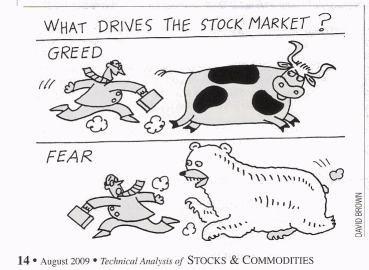
Oh, don't mistaken that your subconscious mind can be dominated by fear only. It can also be dominated by greed! Recently I have been talking to my manager and he described those "glorious" days back in the dot com bubble. He talked about how everyone in his company just day trades in the morning at work. The company produces nothing and just the mere existence of the company and the publishing of news would make the share price goes higher and higher. The employees in these companies GENUINELY BELIEVE that they will day trade for a few years, and after that they can exercise their stock options so they will all retire. What insanity! And I refuse to believe that these very smart people cannot intellectually comprehend that something is wrong and this won't work out. I have to believe that it is their little voice in their head convincing them the party will last forever!
And if you let your subconscious override your conscious mind every time (no matter the subconscious is in the form of fear or greed), you have lost all of your conscious mind. Therefore, the best word to describe you is unconscious.
Let's remember that money does not make you rich. It is financial intelligence that makes you rich. Since YOU are the one who can help you gain financial intelligence, and no one can stop you from doing so (intelligence is probably one of the most personal asset), then it is very obvious that YOU are the biggest enemy for yourself.
You may think this sounds like some corny quotes from mangas like "you must defeat yourself before you defeat others", but let me explain.
Most people should understand the concepts of the conscious mind and the subconscious mind. However, it is important for us to know how these minds work in real life.
Suppose you are planning to buy some stocks. You have done your homework in the company. The company has good management, solid bottom line, and has always given out good dividends. You see a very good opportunity that you can buy the stocks, earn some good dividends, and can potentially sell some of the shares and earn some awesome capital gains in a few years. Your conscious mind understands very well that making the investment is a good idea. However, just when you want to buy the stocks, there is this little voice in your head, saying things like "that's a lot of risk", "how do you know the company is not hiding something", "the market is so uncertain, don't take the risk", and so on. This is your subconscious mind talking! When people try to push themselves outside of their comfort zone, very often their conscious mind and their subconscious mind DO NOT work together and WORK AGAINST each other. Those who succeed often cross this barrier to defeat the little voice in their head, while those who fail will listen to the little voice and stand still.
Oh, don't mistaken that your subconscious mind can be dominated by fear only. It can also be dominated by greed! Recently I have been talking to my manager and he described those "glorious" days back in the dot com bubble. He talked about how everyone in his company just day trades in the morning at work. The company produces nothing and just the mere existence of the company and the publishing of news would make the share price goes higher and higher. The employees in these companies GENUINELY BELIEVE that they will day trade for a few years, and after that they can exercise their stock options so they will all retire. What insanity! And I refuse to believe that these very smart people cannot intellectually comprehend that something is wrong and this won't work out. I have to believe that it is their little voice in their head convincing them the party will last forever!
And if you let your subconscious override your conscious mind every time (no matter the subconscious is in the form of fear or greed), you have lost all of your conscious mind. Therefore, the best word to describe you is unconscious.
This concept of conscious, subconscious, and unconscious is not only related to the development of your financial intelligence. It is related to everything in your life. We all have experienced the conflict of our conscious mind and unconscious mind. When we have an exam in school, instead of studying, we tell ourselves that "I can study more efficiently after a nap", "I need a break from all this work", and so on. When we want to make a needed phone call, we tell ourselves "the other person may be busy", "I will call tomorrow at a better time", and so forth. Our conscious mind knows very well the thing needs to be done, but our little voice is stopping us from doing what's needed!
The problem with most people is that they don't even notice there is a little voice in their head. If you want to overcome your little voice and make it works FOR you instead of works AGAINST you, you must first notice the voice in your head, and identify what it's doing. The reason the subconscious mind is so powerful is because it does everything in stealth! If you can identify the little as soon as it starts ringing in your head, you FORCE the little voice to come out to the conscious mind, and your conscious mind will have a chance to override the subconscious mind (not saying this is an easy battle, but it CAN be done!).
In the next article of this series I will talk about the success cycle and the problem you will face if you do NOT try to overcome your little voice. Stay tuned!
Saturday, 4 August 2012
The Focus of Your Learning
It is always amazing to see how our education system has continuously fails our society. Aside from having kids being "educated" by people with questionable morals (a.k.a. bureaucratic greedy teachers who want to do less and earn more), I found that there are fundamental flaws in the philosophy of the public education. If we are serious about increasing our financial intelligence, we must not make the same mistake as our bureaucratic education system does.
The biggest flaw in the system is this: Our schools put most effort and resources on filling our minds with content, but it does a very poor job in expanding our context.
Your mind is like the cup shown above, and your knowledge and experience is the content in your mind. In school, we are constantly being filled with content, but we only get to rarely and slowly expand our context.
Here is an example of what content and context mean. For instance, we all (hopefully) know the math equation 1+1 = 2. 1+1 = 2 is the content. 1+1 = 3 (in math) is also a content too, but this content will never be in our mind because our context does not allow us to accept this content (and for good reasons).
So what? You may ask. What does 1+1=3 has to do with anything? Well, it has to do with EVERYTHING about learning, for the example implies that you will not be able to fill your mind with content (even if the content is excellent) if you do not possess the proper context! Without the proper context, even excellent content would appear like 1+1=3. For instance, a lot of people have big business ideas, but a common statement these people say is that I don't have the money to realize the great idea. If you encourage these people and tell them that they do not need money to make money, these people will often give replies like "that's impossible", or "it's too risky", and simply dismiss their big dream without taking any actions. As you can see, people like this do not have the context to see that it is possible to realize their dream even if they don't have the money.
On the other hand, for people in 90% Guardian, we understand that $0 to $XXXXXX is only a financial problem. We may not know how to solve it, but we will never say it is not possible and not solvable; we will say we lack the necessary financial intelligence! With the proper context, we know if we want to solve this problem, we just need to increase our financial intelligence, so we will take actions to increase our financial intelligence to realize our great ideas!
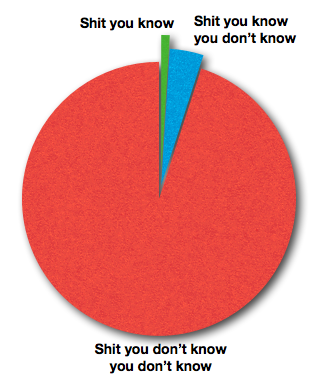
Another way of looking at this is what I called the 3-knowledge model. Knowledge in this world can be categorized in 3 ways: Shit you know, shit you know you don't know, and shit you don't know you don't know. The question is, which type of knowledge should be your focus, if you want to gain intelligence?
Consider this example. Say you are a stock trader. You see that company ABC is going to publish its earning report. First, it comes the shit you know. You know that when a company's earning beats expectation, the stock price would soar and you can sell. In addition, based on your research, it looks like company ABC is doing well and it looks like the company's earning would beat expectation. Based on your shit your know, you buy some shares of this company.
Next, you know that you cannot predict the future, hence you want to have some insurance so just in case things turn the other way, your loss is limited. Now shit you know your don't know hits. You know it is important to "insure" your investment, but you don't know how. Upon some quick research, you learned that you can place a sell stop order to limit your loss. You don't want to lose more than 5%, so you placed a sell stop order at 5% below your purchase price.
To your surprise, the earning report completely disappoints, and as a result there is a massive sell-off which made the price collapsed in a very short time. Now the shit you don't know you don't know hits (hard). You have never imagined that there is a possibility that a stop order would not be exercised at your specified price! However, what happened was that because price dropped so fast, your stop order was gapped/skipped at the specified price, and the shares were never sold at a 5% loss but at a greater loss!
To make you feel even worse, because you were stuck with conventional financial advice and dismiss stock options as "too risky", you never dare to imagine that you could have more securely insured your investment by buying put options!
In the above example, what is the kind of knowledge that could hit you the hardest? Obviously it's the shit you don't know you don't know. Therefore, the path to intelligence is to reduce your "shit you don't know you don't know", and turn as much of them as possible to "shit you know" or "shit you know you don't know". However, schools mainly focus on turning your "shit you know you don't know" into "shit you know", and does very little in reducing your "shit you don't know you don't know".
How can we expand our context? Below are things I personally do (and I am trying my hardest and my best to do them). If you have other ideas, please share!
- Be a good listener. If you find yourself drafting a reply while listening someone talks, THEN YOU ARE NOT LISTENING. Yes, it's tempting to think of what you should say, and sometimes the talker may be boring and your spirit wants to go to lala land, BUT DON'T! Listening to others exposes you to different contexts and how different contexts see things differently. This is a great way to expand your own context! (I admit this part I am having serious trouble, and am furiously working on it)
- Be open-minded. If you hear something that is so unrealistic and so out-of-wreck, DO NOT SIMPLY DISMISS THE INFORMATION. If you think something is unrealistic, it's either that person's statement is actually unrealistic, OR you lack the CONTEXT necessary to appreciate the CONTENT! Listen carefully, try your best to understand, ask questions, and you shall learn. Never be a fool or a cynic. A fool would accept any content, while a cynic would dismiss any content. Be neither and you will thrive!
- Take actions that scare you. Taking action is the best way to push your context! When you feel your forehead starts sweating, your heart starts rapidly pounding, and your blood starts warming, these are signals that are saying you are at the boundary of your context. Take actions! It may be hard, and we are all guilty of wanting to go back to our comfort zone, but JUST DO IT! No matter you succeed or fail, you will be able to see a different world, as you have just expanded your reality!
Subscribe to:
Comments (Atom)