Sunday, 12 August 2012

Your Biggest Enemy (1): Conscious, Subconscious, and Unconscious

Who is the biggest enemy you have to overcome in your journey to financial freedom?
Let's remember that money does not make you rich. It is financial intelligence that makes you rich. Since YOU are the one who can help you gain financial intelligence, and no one can stop you from doing so (intelligence is probably one of the most personal asset), then it is very obvious that YOU are the biggest enemy for yourself.

You may think this sounds like some corny quotes from mangas like "you must defeat yourself before you defeat others", but let me explain.


Most people should understand the concepts of the conscious mind and the subconscious mind. However, it is important for us to know how these minds work in real life.

Suppose you are planning to buy some stocks. You have done your homework in the company. The company has good management, solid bottom line, and has always given out good dividends. You see a very good opportunity that you can buy the stocks, earn some good dividends, and can potentially sell some of the shares and earn some awesome capital gains in a few years. Your conscious mind understands very well that making the investment is a good idea. However, just when you want to buy the stocks, there is this little voice in your head, saying things like "that's a lot of risk", "how do you know the company is not hiding something", "the market is so uncertain, don't take the risk", and so on. This is your subconscious mind talking! When people try to push themselves outside of their comfort zone, very often their conscious mind and their subconscious mind DO NOT work together and WORK AGAINST each other. Those who succeed often cross this barrier to defeat the little voice in their head, while those who fail will listen to the little voice and stand still.
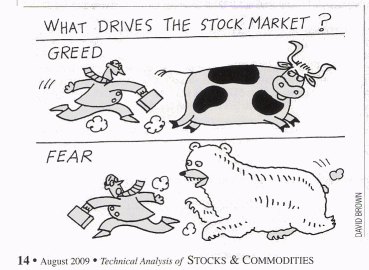

Oh, don't mistaken that your subconscious mind can be dominated by fear only. It can also be dominated by greed! Recently I have been talking to my manager and he described those "glorious" days back in the dot com bubble. He talked about how everyone in his company just day trades in the morning at work. The company produces nothing and just the mere existence of the company and the publishing of news would make the share price goes higher and higher. The employees in these companies GENUINELY BELIEVE that they will day trade for a few years, and after that they can exercise their stock options so they will all retire. What insanity! And I refuse to believe that these very smart people cannot intellectually comprehend that something is wrong and this won't work out. I have to believe that it is their little voice in their head convincing them the party will last forever!

And if you let your subconscious override your conscious mind every time (no matter the subconscious is in the form of fear or greed), you have lost all of your conscious mind. Therefore, the best word to describe you is unconscious.

This concept of conscious, subconscious, and unconscious is not only related to the development of your financial intelligence. It is related to everything in your life. We all have experienced the conflict of our conscious mind and unconscious mind. When we have an exam in school, instead of studying, we tell ourselves that "I can study more efficiently after a nap", "I need a break from all this work", and so on. When we want to make a needed phone call, we tell ourselves "the other person may be busy", "I will call tomorrow at a better time", and so forth. Our conscious mind knows very well the thing needs to be done, but our little voice is stopping us from doing what's needed!

The problem with most people is that they don't even notice there is a little voice in their head. If you want to overcome your little voice and make it works FOR you instead of works AGAINST you, you must first notice the voice in your head, and identify what it's doing. The reason the subconscious mind is so powerful is because it does everything in stealth! If you can identify the little as soon as it starts ringing in your head, you FORCE the little voice to come out to the conscious mind, and your conscious mind will have a chance to override the subconscious mind (not saying this is an easy battle, but it CAN be done!).

In the next article of this series I will talk about the success cycle and the problem you will face if you do NOT try to overcome your little voice. Stay tuned!

Saturday, 4 August 2012

The Focus of Your Learning

It is always amazing to see how our education system has continuously fails our society. Aside from having kids being "educated" by people with questionable morals (a.k.a. bureaucratic greedy teachers who want to do less and earn more), I found that there are fundamental flaws in the philosophy of the public education. If we are serious about increasing our financial intelligence, we must not make the same mistake as our bureaucratic education system does. 

The biggest flaw in the system is this: Our schools put most effort and resources on filling our minds with content, but it does a very poor job in expanding our context.


Your mind is like the cup shown above, and your knowledge and experience is the content in your mind. In school, we are constantly being filled with content, but we only get to rarely and slowly expand our context.

Here is an example of what content and context mean. For instance, we all (hopefully) know the math equation 1+1 = 2. 1+1 = 2 is the content. 1+1 = 3 (in math) is also a content too, but this content will never be in our mind because our context does not allow us to accept this content (and for good reasons).


So what? You may ask. What does 1+1=3 has to do with anything? Well, it has to do with EVERYTHING about learning, for the example implies that you will not be able to fill your mind with content (even if the content is excellent) if you do not possess the proper context! Without the proper context, even excellent content would appear like 1+1=3. For instance, a lot of people have big business ideas, but a common statement these people say is that I don't have the money to realize the great idea. If you encourage these people and tell them that they do not need money to make money, these people will often give replies like "that's impossible", or "it's too risky", and simply dismiss their big dream without taking any actions. As you can see, people like this do not have the context to see that it is possible to realize their dream even if they don't have the money. 

On the other hand, for people in 90% Guardian, we understand that $0 to $XXXXXX is only a financial problem. We may not know how to solve it, but we will never say it is not possible and not solvable; we will say we lack the necessary financial intelligence! With the proper context, we know if we want to solve this problem, we just need to increase our financial intelligence, so we will take actions to increase our financial intelligence to realize our great ideas!


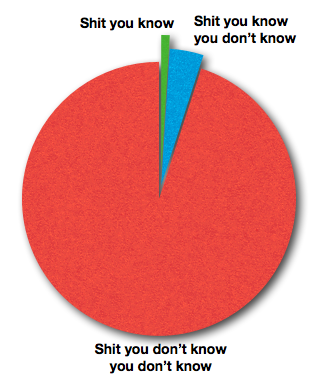
Another way of looking at this is what I called the 3-knowledge model. Knowledge in this world can be categorized in 3 ways: Shit you know, shit you know you don't know, and shit you don't know you don't know. The question is, which type of knowledge should be your focus, if you want to gain intelligence?


Consider this example. Say you are a stock trader. You see that company ABC is going to publish its earning report. First, it comes the shit you know. You know that when a company's earning beats expectation, the stock price would soar and you can sell. In addition, based on your research, it looks like company ABC is doing well and it looks like the company's earning would beat expectation. Based on your shit your know, you buy some shares of this company. 

Next, you know that you cannot predict the future, hence you want to have some insurance so just in case things turn the other way, your loss is limited. Now shit you know your don't know hits. You know it is important to "insure" your investment, but you don't know how. Upon some quick research, you learned that you can place a sell stop order to limit your loss. You don't want to lose more than 5%, so you placed a sell stop order at 5% below your purchase price.


To your surprise, the earning report completely disappoints, and as a result there is a massive sell-off which made the price collapsed in a very short time. Now the shit you don't know you don't know hits (hard). You have never imagined that there is a possibility that a stop order would not be exercised at your specified price! However, what happened was that because price dropped so fast, your stop order was gapped/skipped at the specified price, and the shares were never sold at a 5% loss but at a greater loss!

To make you feel even worse, because you were stuck with conventional financial advice and dismiss stock options as "too risky", you never dare to imagine that you could have more securely insured your investment by buying put options!


In the above example, what is the kind of knowledge that could hit you the hardest? Obviously it's the shit you don't know you don't know. Therefore, the path to intelligence is to reduce your "shit you don't know you don't know", and turn as much of them as possible to "shit you know" or "shit you know you don't know". However, schools mainly focus on turning your "shit you know you don't know" into "shit you know", and does very little in reducing your "shit you don't know you don't know".


How can we expand our context? Below are things I personally do (and I am trying my hardest and my best to do them). If you have other ideas, please share!
  1. Be a good listener. If you find yourself drafting a reply while listening someone talks, THEN YOU ARE NOT LISTENING. Yes, it's tempting to think of what you should say, and sometimes the talker may be boring and your spirit wants to go to lala land, BUT DON'T! Listening to others exposes you to different contexts and how different contexts see things differently. This is a great way to expand your own context!   (I admit this part I am having serious trouble, and am furiously working on it)
  2. Be open-minded. If you hear something that is so unrealistic and so out-of-wreck, DO NOT SIMPLY DISMISS THE INFORMATION. If you think something is unrealistic, it's either that person's statement is actually unrealistic, OR you lack the CONTEXT necessary to appreciate the CONTENT! Listen carefully, try your best to understand, ask questions, and you shall learn. Never be a fool or a cynic. A fool would accept any content, while a cynic would dismiss any content. Be neither and you will thrive!
  3. Take actions that scare you. Taking action is the best way to push your context! When you feel your forehead starts sweating, your heart starts rapidly pounding, and your blood starts warming, these are signals that are saying you are at the boundary of your context. Take actions! It may be hard, and we are all guilty of wanting to go back to our comfort zone, but JUST DO IT! No matter you succeed or fail, you will be able to see a different world, as you have just expanded your reality!

Thursday, 2 August 2012

Answers to Common Network Marketing Misconceptions

This is a compiled list of claims people usually make regarding to network marketing, and the responses to these claims. Hope the information here would help clarify some common misconceptions on network marketing and would help you understand more about this industry.


CLAIM: Network marketing companies are pyramid schemes

RESPONSE: There are legitimate network marketing businesses helping people reach their financial dreams

To understand why network marketing is not a pyramid scheme, one must first understand what a pyramid scheme is. By definition, a pyramid scheme is a unsustainable system which can only continue its existence when there are new people joining the scheme. Since compensation of these schemes are in a pyramid structure, you always need more people than before you join in order to sustain the scheme. In the end, there are not enough new people joining (or new people are not joining fast enough), and the scheme collapses.


An example of a pyramid scheme is the Canadian Pension Plan. Currently, people who are working need to pay a CPP premium for every pay-chaque they receive. The government takes these premiums and pay the retirees of the society. In this case, when the current working people retire, who's going to pay them? It will be the working people at that time paying these retirees! What if there are not enough working people (birth rate has been going down)? Answer: The whole system collapses.

The main difference between a pyramid scheme and a legitimate network marketing company is that, for a legitimate company, the network marketing is HOW the company markets its product, whereas for a pyramid scheme, the network marketing system IS the only thing the company has to offer.


Here is a more detailed explanation. A sustainable network marketing company is just like any other successful company. It has good products/services competitively priced, good management, a solid mission, a sound business plan, excellent training program, etc. The only difference between a network marketing company and a successful conventional company is that, instead of relying traditional marketing methods like advertisements to promote the products/services, a network marketing company uses a direct sales approach by giving incentives to consumers to help them promote and sell the products/services.

On the other hand, for a pyramid scheme, all of the elements that make a business successful are missing. People buy the "products" or "services" (if they are even present) MAINLY (or even only) because they see they can make money from the "compensation plan". If new people fail to join the scheme, the existing distributors would no longer continue purchasing the products/services (because the products/service either don't give any value, or are drastically overpriced), and the whole scheme collapses.

Are there crooked pyramid schemes that false advertise themselves as legit network marketing company? ABSOLUTELY! Are all network marketing companies scams? DEFINITELY NOT! Just analyze a networking company like any other company to see if the business is sound, and you shall find out whether a network marketing company is legit or not!


CLAIM: The network marketing model is obsolete because of information technology

RESPONSE: Information technology allows people to communicate more easily with people, which empowers network marketers.

Some people believe that the network marketing model was only useful in the old days when towns are sparse, and a network marketing strategy allows a company to make sales to people who the company would not have a chance to reach to. Therefore, in today's world with the worldwide web, a company can easily make an online store for customers to make purchases, so they no longer require network marketers to do the job.

While there is some truth to this, this statement makes the assumption that marketing only involves putting some fancy ads so people can see and make an online store for people to purchase. We all know this is not true. Marketing to have customers buy the product/service requires more work than that. In fact, in today's world that is overwhelmed with information, marketing through direct sales have became more effective. Consider the last time you want to go to a restaurant. Did you just see an ad and then go there to eat, or you try to see if anyone you know has tried the restaurant and see what they think about the place? This example is just to show how a person-to-person interaction is still very powerful for marketing products/services and is NOT an obsolete marketing method.


If marketing using a person-to-person interaction is NOT obsolete, then it is safe to say that information technology makes it even easier for person-to-person interaction to happen, and it empowers network marketer. In the past network marketers could only get to their prospects through in-person meetings or via phone calls, but now they have faster and more interactive methods like video conference available as an option, and network marketers can now reach internationally with the information technology, instead of being stuck only nationally or locally!

All in all, information technology has been nothing but a great blessing to the network marketing industry.


CLAIM: Network marketing is not really a business

RESPONSE: Network marketing is a business that can give you the potential to achieve tremendous wealth

A lot of people think you are just being a sales if you are in a network marketing business. While there is some truth that sales play an important role, a network marketing business is nothing but a business.

Remember the definition of being a big business owner is that you own a system that works for you and gives you money no matter you work or not. In network marketing, if you have built and trained your downlines correctly, your down-lines would continue to purchase products/services, make more sales, and recruit more distributors. If you have built your downline organizations correctly, it will generate cash flow no matter you work or not!

This, by definition, is a business!


CLAIM: Only the top dogs get the big bucks

RESPONSE: That's true, but so what?

In fact, isn't that how everything works in life? If you work in a company, the chief-executives are probably the highest-paid individuals, and then the senior management, then the middle management, and finally the rest of the workers. No one complains the top dog earns the most money in other businesses, so why should this be a drawback for network marketing?

In fact, network marketing gives you a chance to succeed based on your individual effort. Your success is defined by your ability to sell and your ability to lead your organization. You do not have to face the troubles of being more competent than your boss and get paid less. This is the value of being your own boss and running your own business!


CLAIM: Most people fail in the network marketing business

RESPONSE: It's true, but the failure rate is not any worse than starting any businesses

It is said that for businesses, 1 out of 10 would fail after 5 years, and for the next 5 years, only 1 out of 10 that survived the first 5 years survives. This implies that only 1 out of 100 businesses can last more than 10 years, so it's a whopping 99% failing rate.

For network marketing, it is said that about 3% of the people succeed in earning an income comparable to a full time job. The failing rate in network marketing is really nothing special in the world of business.


Furthermore, the consequences of failing is a lot lighter in a network marketing business. For a conventional business, to be successful, people usually need to work full time. Business start-up requires capital so people usually are in debt. Shall the business fails, not only do people lose their income, they also need to repay their debt!

For network marketing, however, you can easily start part-time and work in your own pace to acquire the skills you need to build the business. While in a conventional business, time is not your friend as you have the pressure to succeed (to repay the debt, mainly), in network marketing you can work according to your own pace. If the result is a failure, thanks to the small initial investment, you can still walk away easily and hopefully take with you valuable knowledge you learned while trying to build this business!

Wednesday, 1 August 2012

Definitions of Some Common Terms

The following are definitions of terms I learned over the years (no, I didn’t make these up myself). You may know some of these already, which is great. If not, I hope you learn something from my definitions (no matter you agree or disagree with them)! If you have better definitions, please share!


Asset VS Liability

This is probably two of the most important terms that people mess up in the definition, and it makes people go into deep financial trouble.

In financial accounting, we are taught that asset is something you own, and liability is something you owe. It makes sense from an accounting perspective but will totally kill you if you use these definitions in your financial life.


Definitions

Assets: Items that put money in your pocket no matter you work or not.
Liabilities: Items that take money out of your pocket no matter you work or not.


Implication

The problem for most people is that they know assets are good things, but they mistaken the wrong things as asset.

For example, if I buy stocks that pay me dividends, that's assets.
If I buy physical gold and silver and hold them, they can be assets or liabilities. If I sell at a price higher than I bought, it's an asset. If I sell at a loss, it's a liability.
If I buy a house to live and pay mortgage and maintenance every month, the house is a liability. Unless later I rent it out and make a profit every month, or I sell it at a higher price and minus all the expenses I paid and there is still a profit, THEN the house becomes an asset.

Asset and liability are always mistaken by people, and if someone claims that they have financial knowledge, it is unforgivable for them to get this wrong. If you are looking for a financial adviser and s/he says junk like "your house is your biggest asset", you should fire the adviser.


Poor, Middle Class, and Rich

There are 2 ways to define the class of poor, middle class, and rich.


Definitions

1. By income (more conventional definition).

Poor: $0 - $25,000 per year
Middle Class: $25,000 - $100,000 per year
Affluent: $100,000 - $1 million per year
Rich: $1 million or more per year
Super Rich: $1 million or more per month

2. By cash flow.

Since we always stress that money does not make you rich, we can also look at cash flow of a person to see whether the mindset of the person belongs to poor, middle class, or rich.

Poor: Money comes in as (most cases) earned income, and goes away in the form of expense.
Middle Class: Money comes in as (usually) earned income, and goes away in the form of expense and liability payments.
Rich: Money comes in as passive income or capital gains, and goes into building and acquiring more assets.


Implication

Both definitions are useful.

The first definition provides you a guideline of the income you need for the life style you want. This is also exceptionally useful when you try to define your exit strategy for your retirement. Do you want to retire as a poor, middle class, or rich? Build that amount of passive income and you should be rewarded to the life style accordingly.

The second definition is useful to read beyond income level to see someone's financial mindset. It is NOT telling you to be judgmental, but in life it is useful to understand the mindset of others. For example, if you want to get financial advice, do you want to get advice from a poor, a middle class, or a rich? If you understand this definition, you will understand that someone who earns $1 million per month may not be rich after all, if his/her cash flows shows a different mindset than the rich.


Rich and Wealthy
Being rich (in this case this is an adjective, not a class of people) and being wealthy mean very different things (though they can be related).


Definitions
Rich: There is an abundance.
Wealthy: The number of days you can live the current life style if you quit working today.


Implication
By definition, you can be rich in many ways. You can be rich with friends if you have a lot of friends. You can be rich with love if a lot of people love you dearly. If you have an abundance of money, then you are financially rich.

Being wealthy, however, is a very different animal. Just as health is measured in time (for example, someone who only has a few years of life left is less healthy than someone who can still live 30 more years), wealth is also measured in time. If you are wealthy, it means you can live in your current life style without working. This would also imply that just because you have a high income or a high paying job, does not mean you are wealthy!

The further implication here is that, if your wealth is larger than your health (you can last longer financially than you can live), or if your wealth is infinity (passive income > expense), then you achieved financial freedom!


Investment VS Speculation
It is vital to distinguish between investing and speculating, as most people may not even know the difference between the two.


Definitions
Investing: When you put your money in, you earn money from day one. You make profit when you BUY.
Speculating: You put your money in, and hope later you can sell at a higher price. You make profit when you SELL.


Implication
There is nothing wrong for playing the investment game or speculation game. It's a personal choice and you can get rich either way. However, speculation requires a lot more skills than investment, as risks are higher because you don't get anything during the speculation period. When you speculate, time is not your friend, as you reduce the velocity of your money if you let the money gets trapped too long (not to mention tax code is not as favorable toward speculation).

The problem nowadays is that most people with little to no financial knowledge SPECULATE in the market (be it stocks, real estates, bonds, or anything), and they think they are INVESTING. Again, if a financial adviser comes by and tells you to "invest in a mutual fund for long term", but the mutual fund gives you no dividend and you can only hope for capital gain, consider firing the financial adviser and call him/her a quack.


Leadership VS Management
In general, there are 3 different characteristics between a leader and a manager.


Definition
Characteristic 1:A leader focuses on doing the right things, and a manager focuses on doing things right.

Characteristic 2:A leader is at the front line showing others the way to go, and a manager sits at the back overseeing the progress of the work.

Characteristic 3:Leaders must be able to surround themselves and work with people smarter than they are, whereas managers often work with people less capable than they are.


Implication
Both leadership and management are good skills to have. However, if you want to be a successful entrepreneur and/or investor, you need to develop your leadership instead of management.