
I can't believe I am writing this. When I first touched the investing arena, I have liked Warren Buffett just like many people did. But now, after I learned a thing or two more than before, and grew a bit older (and hopefully wiser), I learned that Warren Buffett is nothing but a political and financial hack who somehow, through his influence, made himself appear as "the guardian of the little people" in the lamestream media (and the ridiculous part is people bought the story).
But in this article, I want to share some of his wisdom. Warren Buffett is still (don't know how long it will be) regarded as one of the best investors in the world. He does share his thoughts with people. However, when listening to him (even when he is actually sharing something legit), it is very easy to misunderstand what he actually means. People who merely listen and don't have the financial intelligence to "decode" his saying will often get slaughtered in the end because they misunderstand the concept Buffett is sharing.
This article is to "decode" some of the wisdom that Buffett has.
So, without further ado, let's go into what Warren Buffett has to say!
Buffett said: "Rule #1: Never lose money. Rule #2: Never forget Rule #1."
People without an investor mindset, upon hearing this, would just decide to stay out of the investing arena and "play it safe" (possibly do something non-sense like buying into a GIC or some government bonds). However, with a bit of common sense, we will see that what most people consider at "risk-free" investment is only a "guaranteed loss" thanks to inflation and low interest rate. How is it following Buffett's wisdom when all your are guaranteed is a steady loss?
The truth is, real investors do a lot of due diligence to understand an investment before putting money in the game. Real investors understand their returns and their risks. Real investors invest with insurance. For example, in the stock market, you can sell puts to buy stocks at discount, and sell calls to cash-flow your stocks risk-free. In the commodity market, you can study supply and demand of an item and predict the long term trend of price movement. These are some examples of how people can earn money simply by learning how to play the game. By enhancing your knowledge, you can ensure you won't lose money and will make great returns!
Real investors ensure their investment won't lose money. They do not put their money into so-called "risk-free" investment vehicles that guarantees nothing except loss.
Buffett said: "Only buy something that you'd be perfectly happy to hold if the market shut down for 10 years."
Buffett said: "Our favorite holding period is forever."

In my opinion, this is the most often cited and most misunderstood statement made by Warren Buffett. Maybe you've seen someone like this too. When you ask them how their investments are doing, they reply, "I am a long-term investor. Have you ever heard what Buffett said?"
These people who say this kind of things often are losing money. And because they are losing money, they are in for the long-term. Heck, I was also like this in the past!
The problem with these people is that, they thought the holding period of an investment is determined by themselves, so they are holding their investment for "long-term", believing that long-term investors always win. This is a completely wrong concept. The truth is, the INVESTMENT determines the holding period of an investment, not the INVESTOR!
Let's look at an extreme example. If there is an investment that give you 100% cash flow, and appreciate in value 100% annually (in real value), how long would you hold this investment? I hope your answer is forever.
What about an investment that loses 50% value everyday? How long would you hold this investment? I hope your answer is never. But the funny part is, some people would decide to hold an investment like this for the long-term, just becasue Buffett said "You shouldn't hold something for a minute if you are not planning to hold it for 10 years."
So to recap, the INVESTMENT, not the INVESTOR, determines how long one should hold an investment for. The investor's job is to find the excellent investment that is good to hold on to forever, and sit on it forever, NOT holding onto every investment forever.
Buffett said: "Wide diversification is only required when investors do not understand what they are doing"

When people mention diversification, they usually means they have money into stocks of different sectors and industries, and maybe also some money in bonds.
This is the kind of diversification that Buffett condemns.
True diversification is diversification into different asset classes. This means putting money into businesses, paper assets (stocks, bonds, etc), real estates, and commodities. Just look at Warren Buffett himself. He has a business (Bershire Harthaway) that invests in other businesses and different paper assets. Diversification is great, but it's non-sense to just go wild in one asset class and think you are diversified.
Buffett said: "Derivatives are financial weapons of mass destruction."

Derivative is simply "an item that is derived from another item". For example, orange juice is a derivative of orange. Derivatives are not intrinsically evil. For example, when someone buys a house, the mortgage agreement is a derivative of the real estate. This is very normal and there is nothing wrong with it. However, the problem arises when Wall Street gets creative, and then they started to create investments that are based on the mortgage agreement. And then they create investments that are based on the investment that is based on the mortgage agreement. So what you get is a derivative of a derivative of a derivative of a derivative, and on and on and on.
Still, there is nothing intrinsically evil about it. The evil part is when corrupted rating agencies rank these derivatives AAA (meaning risk-free). Just by understanding the concept of a derivative, we can see they are very high risk, since if any part of the derivative chain shows weakness, the derivative gets destroyed. When these poisonous investments get rated as "AAA", you get people world-wide buying them. Even funds that would usually go for low-risk investments, ended up getting these poisonous assets. Once the underlying asset value goes down the drain, then so does all the derivatives derived from it. In this case, it is definitely weapons of financial mass destruction (on a side note, why the rating agencies are still in business and people still take them seriously is beyond me).
However, to sound like a broken record, THERE IS NOTHING INTRINSICALLY WRONG WITH DERIVATIVES. Derivatives can be weapons of mass financial destruction and can also be weapons of mass financial creation. It just depends on how it is used.
The lamestream media most often only cite Buffett's quote of financial mass destruction, but they often leave out the one below, which I believe Buffett explains it best of the nature of derivatives:
"We've used derivatives for many, many years. I don't think derivatives are evil, per se, I think they are dangerous. ... So we use a lot of things daily that are dangerous, but we generally pay some attention to how they're used. We tell the cars how fast they can go."
Addendum: Warren L.C. Buffett (Warren Liar.Crook. Buffett)

WARNING: IF YOU REALLY LOVE BUFFETT AND ALL YOU WANT TO READ IS HOW GREAT WARREN BUFFETT IS, AND HAVE NO INTEREST IN LEARNING OTHERWISE, YOU SHOULD STOP READING AT THIS POINT. ELSE, KEEP READING.
NOTE: I AM MERELY STATING FACTS HERE, AND AM NOT RESPONSIBLE FOR ANY HURT FEELING THAT THE WRITING MAY CAUSE.

Buffett said: "If you're in the luckiest 1% of humanity, you owe it to the rest of humanity to think about the other 99%"
Good job Buffett, what a hypocrite you are! If what you say is true, then obviously you never think about or care for the other 99%. Remember the bailout in 2008? Why did you support it? Oh, that's right, if there were no bailout, you would've lost your under pant already. If the government DID NOT PRINT SO MUCH MONEY TO LOOT THE WORLD POPULATION'S PURCHASING POWER AND GIVE IT TO YOU AND YOUR CRIMINAL WALL STREET FRIENDS, you would be broke by now! DAMN RIGHT YOU OWE THE OTHER 99%. When the hell are you going to pay us back?
So much for thinking about the other 99%. The truth is, true capitalists DO NOT need to think about the other 99% (though many of them, unlike Warren, do), because as they make profit, they are providing values to the society and are creating a better world (heck, this is why true capitalism is so beautiful... you can make other people better off by just thinking how to enrich yourself!). Steve Jobs is possibly one of the biggest known assholes in the Silicon Valley, and yet when he was alive he was constantly being idolized by the public. Why? Because THROUGH HIS PROCESS OF ENRICHING HIMSELF, HE CREATED VALUES FOR EVERYONE IN THE WORLD!
But financial hacks like you, Warren, would never understand free market economics, because you haven't created values for the 99% for a long time, and you don't care about them. Walk your talk for once, please (but I bet you will not until you lose your under pant).

Buffett said: "If anything, taxes for the lower and middle class and maybe even the upper middle class should probably be cut further. But I think that people at the high end - people like myself - should be paying a lot more in taxes. We have it better than we've ever had it."
What a crook Warren. Can you be honest just once?
First, if you loooooooooooooooooooooooooooooooooooove to pay tax, no one is stopping you from writing a big fat cheque to the US treasuries. I am sure your criminal friends in Washington D.C. would appreciate it.
Second, question: Who creates jobs in the society for the middle-class and the poor? That's right, the rich! Oh, you are going to tax the rich more. Great! Less capital for the rich, so less jobs will be created! Then why should we lower taxes for the poor and the middle-class; they wouldn't even have an income to pay tax anyways!
Third, only people who own mega corp like you, Warren, are not paying taxes. You can hire hundreds of accountants to do tricks to avoid paying taxes "legally", while a smaller business does not have the resource as you do. In fact, rich people are taxed to the hill. If they own a business, the business pays a corporate tax. And then, if the rich person has income from the business, those income gets taxed. Real tax rate is more like 50%, and we want to tax them more so there is less capital for the society?

You know what, Warren, I have a better idea. How about we LOWER TAX ACROSS THE BOARD FOR EVERYONE? The society will all benefit, except the parasitic government. It would force government to shrink, which is awesome! Why don't we do that?
Oh, I know, because IF GOVERNMENT SHRINKS, GOVERNMENT WOULD NOT HAVE "GOODS" TO SELL TO CROOKS LIKE YOU, Warren. Without the government's power to help you out (like bailing your buddies out so you can earn big), you would not have the competitive advantage! Moreover, if we lower tax rate for rich people, the smaller businesses would become more competitive and compete with you! Of course you don't want it!
You can fool others, but narrow-minded self interest does not impress me.
Buffett said: "Gold gets dug out of the ground in Africa, or some place. Then we melt it down, dig another hole, bury it again and pay people to stand around guarding it. It has no utility. Anyone watching from Mars would be scratching their head."

This is a famous quote by Warren L.C. Buffett on gold. A lie cannot be as blatant as this.
First, gold has HUGE utility. No, not just for jewelry. Do you know the little brother of gold named silver? Silver is the second most useful commodity in the world (oil is the first). Now, do you know what the perfect substitute of silver is? That's right, it's GOLD.
And gold has no utility according to L.C. Buffett
The reason that people DON'T use gold is because gold is too expensive. In fact, back in the days when gold's price was low, Intel would use gold to make something like the following:
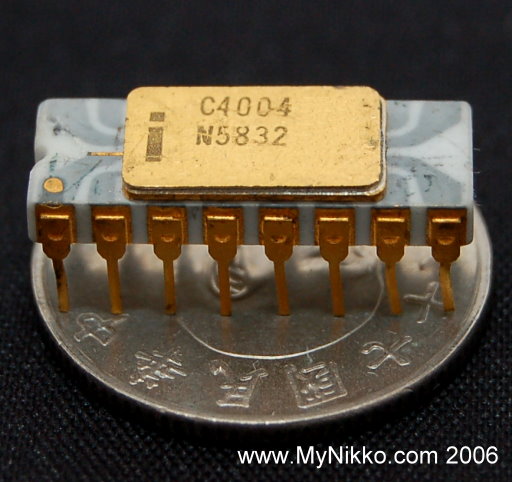
And gold has no utility according to L.C. Buffett.
Gold actually has HUGE utility, but people don't use it because historically, gold's financial value is a lot higher than its utility value. Let me explain this with an example: Take out a 5 dollar bill from your wallet. Your 5 dollar has the utility of creating heat when you burn it (it's sad that you can't even write on it because they already put ink on the paper). But would you burn it? NO, because the 5 dollar bill has a value higher than the heat it creates (at least for now, before the fiat currency collapses).
Historically, many items have been used as money by humans (salt, gems, shells, stones, etc). But the only item(s) that are used and accepted by everyone has been gold and silver. The British smuggled opium to China and fought the opium war because the British was running out of silver due to high volume purchases of Chinese goods (great trade deficit created deflation in United Kingdom). The Spanish crossed the Atlantic to go to the New World to find gold. GOLD IS MONEY.
And it has no value according to L.C. Buffett.
You might say, "well, Warren Buffett's concentration is on business and paper assets. He might just not understand gold and silver and he's not deliberately lying."
Oh yeah? Sure. Although I would never believe one of the greatest investors in the world would not understand gold, I would give him the benefit of the doubt. How about we take a look at what this man named Howard Buffett has to say about gold?

I warn you that politicians of both parties will oppose the restoration of gold, although they may outwardly seemingly favor it, unless you are willing to surrender your children and your country to galloping inflation, war and slavery then this cause demands your support. For if human liberty is to survive in America, we must win the battle to restore honest money. There is no more important challenge facing us than this issue - the restoration of your freedom to secure gold in exchange for the fruits of your labors.
Howard Buffett is Warren Buffett's father. He was a congressman of the United States of America. Throughout his political life he fought to restore constitutional money in the society (did I tell you by the US constitution, only gold and silver can be money... so the current US Dollar backed by nothing is actually illegal?)
And you want me to believe that, as the son of Howard Buffett, Warren does not understand the financial role gold and silver plays in a honest money system for the society? Give me a break.
Warren, your father was a true hero, and you are nothing but a crook. He was un-corruptible and had the guts to stand against the powerful beneficiary of the fiat money system, and yet you sold your soul just so you can make a some bucks.
Your father must NOT be resting in peace seeing how his son helps destroys the constitution he so furiously tried to protect. Good job!
Buffett said: "Of the billionaires I have know, money just brings out the basic traits in them. If they were jerks before they had money, they are simply jerks with a billion dollars."
Well said Warren. That's why you were, you are, and you will always be a liar and a crook. Reason? you explained it very well yourself. WELL DONE.


